All posts by socialontology2019

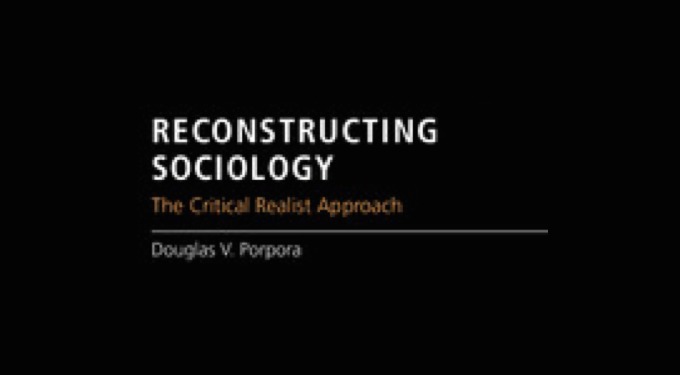
Reconstructing Sociology – Douglas V. Porpora

Critical realism is a philosophy of science that positions itself against the major alternative philosophies underlying contemporary sociology. This book offers a general critique of sociology, particularly sociology in the United States, from a critical realist perspective. It also acts as an introduction to critical realism for students and scholars of sociology.

Written in a lively, accessible style, Douglas V. Porpora argues that sociology currently operates with deficient accounts of truth, culture, structure, agency, and causality that are all better served by a critical realist perspective. This approach argues against the alternative sociological perspectives, in particular the dominant positivism which privileges statistical techniques and experimental design over ethnographic and historical approaches.

However, the book also compares critical realism favourably with a range of other approaches, including poststructuralism, pragmatism, interpretivism, practice theory, and relational sociology. Numerous sociological examples are included, and each chapter addresses well-known and current work in sociology.

Reconstructing Sociology is published by Cambridge University Press. See here for more details.

The Relational Subject – Pierpaolo Donati and Margaret S. Archer

Many social theorists now call themselves ‘relational sociologists’, but mean entirely different things by it. The majority endorse a ‘flat ontology’, dealing exclusively with dyadic relations. Consequently, they cannot explain the context in which relationships occur or their consequences, except as resultants of endless ‘transactions’.

This book adopts a different approach which regards ‘the relation’ itself as an emergent property, with internal causal effects upon its participants and external ones on others. The authors argue that most ‘relationists’ seem unaware that analytical philosophers, such as Searle, Gilbert and Tuomela, have spent years trying to conceptualize the ‘We’ as dependent upon shared intentionality.

Donati and Archer change the focus away from ‘We thinking’ and argue that ‘We-ness’ derives from subjects’ reflexive orientations towards the emergent relational ‘goods’ and ‘evils’ they themselves generate. Their approach could be called ‘relational realism’, though they suggest that realists, too, have failed to explore the ‘relational subject’.

The Relational Subject is  published by Cambridge University Press. See here for publisher details or here for Amazon.

The Social Ontology of Digital Data & Digital Technology, July 8th in London

This innovative conference brings together leading figures from a variety of fields which address issues of digital technology and digital data. We’ve invited speakers with a range of intellectual perspectives and disciplinary backgrounds who engage with questions relating to digital data and digital technology in their work. Our suggestion is that social ontology, however this might be construed, represents a potential common ground that could cut across this still rather siloed domain of inquiry into the social dimensions of digital technology.

The conference aims to explore this possibility by assembling a diverse range of perspectives and drawing them into a dialogue about a common question, without assuming a shared understanding of the topic at hand. Our aim is to extend this digitally via twitter, podcast and blog beyond the event itself, in order to facilitate an extended conversation that will draw more people into its remit as it circulates after the conference itself.

To this end, we invite each speaker to address this theme (the social ontology of digital data & digital technology) in whatever way they choose. Each speaker will have 30 mins to talk and 15 mins for questions. We’ll have an accomplished audio editor on hand to record each talk as a podcast. These will be released on www.socialontology.org and will be circulated on social media in order to try and stimulate a continuing debate around the issues raised at the conference. The hashtag for the day will be #socialontology.

Confirmed Speakers:

  • Chair: Celia Lury (Warwick)
  • Noortje Marres (Goldsmiths) – Does Digital Sociology have a Problem?
  • Jochen Runde (Cambridge) – Non-materiality and the Ontology of Digital Objects
  • Alistair Mutch (NTU) – Organizational Implications of Digital Data
  • Susan Halford (Southampton) – title TBC
  • Nick Couldry (LSE) – title TBC
  • Emma Uprichard (Warwick) – Big Data, Complexity and Time.

Eventbrite - The Social Ontology of Digital Data & Digital Technology

This event is funded by the Independent Social Research Foundation

Our PhD/ECR Conference

Centre for Social Ontology PhD/ECR Conference
June 23rd, University of Warwick, 10am – 4pm

Social ontology is integral to the study of society. It is impossible to inquire into the social world without some understanding, at least tacitly, concerning the entities which make up that world and their properties and powers. However social ontology remains an often confused and contentious matter within the social sciences.

The conference is open to all PhD students and Early Career Researchers with an interest in social ontology.

This event is funded by the Independent Social Research Foundation

Margaret Archer to speak at Epistemology, Method and Complexity

Epistemology, Method and Complexity

Warwick, Friday 8 May 2015

12.45-5.15, followed by Drinks Reception

Hosted by the Centre for Interdisciplinary Methodologies, University of Warwick

Places are free but please REGISTER HERE.

In this fifth seminar, we explore one of the issues that has already started to emerge across all the seminar so far: epistemology. In particular, this seminar aims to unpack some of the ways in which different kinds of epistemological positions that tend to be implicit in complexity discussions in general. One of the features that has become clear to the seminar series organisers series is the ways in which each seminar as so far tended to ‘divide’ the seminar participants, with particular members preferring certain seminars over others in a way that tends to also map on to their respective disciplinary backgrounds.

In spite of the different approaches to complexity that are so obviously present across the disciplines, one of the aims of this seminar series has been to prioritise the social and to explore what a complex social systems methodological approach might entail. With this in mind, we return to some fundamental concepts in social science as way of exploring how they may or may not be turned on their head from a complex systems perspective.

In doing so, this seminar focuses on two aspects of the social that we consider to be fundamental to a complex systems approach, namely agency and evaluation. Often these concepts tend to sit separately to one another and they also tend not to be key priorities within complexity approaches in general either. Here, therefore, we bring them together as a way of rethinking some of the key ways we might begin to formulate what an empirical complex systems approach look like, if it acknowledged the importance of agency and evaluation together.

This seminar will follow a slightly different format to previous seminars in that we have chosen to only have a small number of key speakers and a larger audience. This will, though, still allow us plenty of time for some good discussion.

The speakers are:

Professor Margaret Archer, Sociology, University of Warwick University, Centre for Social Ontology.

Professor Edmund Chattoe-Brown, Sociology, Lancaster

Dr Ana Teixeira de Melo, Center for Social Studies, Faculty of Psychology and Education Sciences, University of Coimbra

Professor Malcolm Williams, School of Social Sciences, Cardiff University

The Fourth CSO Workshop: Morphogenesis and Normativity

The fourth annual CSO workshop was held from January 6th to January 9th in 2015 at Cardiff Business School. The papers from the workshop will be published in 2015 as the fourth volume of the Social Morphogenesis series.

Tuesday 6th

Doug Porpora – The Great Normative Changes of the Twentieth Century

Wolfgang Hofkirchner – Ethics from Systems: the emergence of normativity with and in social systems

Phil Gorski – Reflexive Secularity

Pierpaolo Donati – The relational understanding of the origin and morphogenetic change of social morality

Wednesday 7th

Margaret Archer –  Morphogenesis and the interpretation of codified social rules

Ismael Al-Amoudi – In letter and in spirit: Social Morphogenesis and the interpretation of codified social rules

Emmanuel Lazega – Polynormativity and Status Inconsistency: a neo-structural approach to regulation

Colin Wight –  Emergence, Development and Death: Norms in International Relations.

Tony Lawson – Collective practices, norms and modern Economics

Thursday 8th

Andrea Maccarini – A Tale of Two Wars: Ontology, Universality and the Normative Tensions of Morphogenic Society

Mark Carrigan – Fragile Movements Emerging out of Digitalization

Routines and Reflexivity – March 10th

Alistair Mutch (Nottingham Trent University)
MARCH 10TH
17.00-18.30, R1.04
Ramphal Building, University of Warwick

Much of the debate occasioned by the development of ideas about reflexivity and morphogenesis has turned on the status of habit. Whilst recognising the importance of this debate, this seminar takes an alternative tack. Returning to Bhaskar’s formulation of ‘position-practices’, it reviews recent work on organizational routines. Developing a position which sees routines as a key emergent property of organizations, recent developments in information technology are seen to cement autonomous reflexivity. Accompanied by an increasing discourse of ‘strategizing’, this might limit the development of meta reflexivity.

All welcome! E-mail socialontology@warwick.ac.uk with any questions

An eclectic account of lay morality and charitable giving in the UK – Feb 17th

Balihar Sanghera (Kent)
Tuesday, February 17th
5:00 PM to 6:30 PM, R1.04
Ramphal Building, University of Warwick

This paper examines how charitable giving is an outcome of different interacting elements of lay morality. Charitable giving reflects people’s capacity for fellow-feeling (or sympathy), moral sentiments, personal reflexivity, ethical dispositions, moral norms and moral discourses. An eclectic account of lay morality and charitable giving is warranted because of the complex nature of the object. Though ordinary people engage in ethical reasoning, they often think and act in piecemeal fashion, so that confusion and inconsistencies can occur. This is particularly evident when gender, class and ‘race’ shape people’s feelings and evaluations of others, their attention and care for others, and their understanding of responsibility and blame for social issues. Morality is further complicated because it takes place in the mundane world of everyday life that can result in inconsistent and confusing judgements and actions on giving.

All welcome! E-mail socialontology@warwick.ac.uk with any questions